Masada National Park (גן לאומי מצדה)
History, Heritage, And Nature
For its part, the last stronghold of Jewish freedom fighters against the Roman army symbolizes the responsibility of the Kingdom of Judah at the end of the Second Temple period and its violent destruction. On the mountain, the platform is the remains of magnificent palaces from the time of King Herod and silent testimonies to the Roman siege and the bitter end. The mountain became a symbol.
(Masada in old-fashioned spelling) is an ancient fortress on the summit of a secluded cliff, on the eastern edge of the Judean Desert, which rises to a height of 63 meters above sea level, and about 450 meters above the Dead Sea at its foot.
In the days of the Great Revolt, the last of the rebels against Rome entrenched themselves at Masada and turned their desperate fight into a symbol of the struggle for freedom. Because of the enthralling historic events that took place on the mountain, and the archaeological finds that have been revealed there, UNESCO has declared Masada National Park a World Heritage Site
Masada ancient fortress in southern Israel’s Judean Desert. It’s on a massive plateau overlooking the Dead Sea. A cable car and a long, winding path climb up to the fortifications, built around 30 B.C. Among the ruins is King Herod’s Palace, which sprawls over 3 rock terraces, and a Roman-style bathhouse with mosaic floors. The Masada Museum has archaeological exhibits and recreations of historical scenes.
Brief history
The most important historical source for the history of Masada is the writings of Yosef ben Matityahu, a Jewish historian, writer, and general, who lived during the Great Revolt in Rome.
The Hasmonean days
According to Yosef ben Matityahu, the first to fortify the place was Yonatan the High Priest, and he called the place “Masada.” This seems to refer to King Alexander Yanai, who ruled in the years 103-76 BCE. To date, no remains have been discovered in Masada that can be attributed with certainty to this period.
The days of Herod
In 40 BCE Herod and his family fled to Masada from Matityahu the Hasmonean Antigonus, who was ruled by the Euphrates. Antigonus was narrow on Masada, Herod went out to call for help, and the fortified ones almost died of thirst, and only sudden rain saved them from death. On the 1st of Passover, Herod built a fortress in Masada designed to defend his kingdom from outside enemies, as well as to protect it from enemies from within. In the fort, he built a complex of luxury palaces, bathhouses, warehouses, huge cisterns, and a retaining wall. After his death (4 BCE), the Romans stationed a guard corps in the fort.
The period of the revolt
During the revolt, beginning in 66 CE, a group of rebels took over Masada, known in the writings of Yosef ben Matityahu as “Sikriim” (they were named after a short sword – Siki – who hid in their clothes). Eleazar ben Yair, who was the commander of the mountain.
The rebels lived in the enclosure walls and in some of Herod’s palaces. They built a synagogue and mikvahs and led a community life. In 73, or 74 CE, after the conquest of Jerusalem, the Roman army arrived at the site and laid siege to the mountain to eliminate the pocket of resistance left in Masada. Under the leadership of General Flavius Silva, the Roman warriors built eight camps and sieges For several months the Romans also built an embankment west of the mountain that reached as far as the walls of Masada. And survived.
The Byzantine period
In the 5th century CE, monks settled in Masada and established a secluded monastery (Laura). Some identify the monastery in Masada with the “Marda” monastery, which is mentioned in the literature of the Church Fathers. This settlement seems to have ceased to exist with the rise of Islam (7th century CE).
Archaeological research in Masada
After the Byzantine period, it was abandoned and forgotten. The site was first identified in 1838 by American researchers Edward Robinson and Eli Smith, and over the years more European and American researchers have excavated in Masada.
Archaeologist Shmarya Gutman is the first Israeli archaeologist to start digging in Masada, in 1953, and he has made many important discoveries. A delegation of senior Israeli archaeologists excavated in Masada in 1956, followed by Yigal Yadin’s excavation delegation in 1963. In the following years, Prof. Ehud Netzer and Dr. Guy Stiebel also excavated in Masada.
Landscape observations
The Eastern Observatory
- Spectacular view of the Dead Sea and the mountains of Moab.
- The observation deck in the northern palace
- A view from Herod’s private palace. From here you can look out over the replica cliff of the Judean Desert, the shores of the Dead Sea, the ancient path to the springs of Nahal Tselim, and towards the Roman dyke.
- The Western Observatory
- A beautiful vantage point over the Judean Desert, the Masada River, and the Roman embankment.
The southern observation post
- An observation point on the replica cliff and Mount Elazar, where the Romans’ eighth camp was located
Animals found in the area
Tristram – A loud bird with a whistle-like call, charcoal black and has orange stripes on the wings, which are especially noticeable during flight. The difference between males and females is noticeable in the color of the head – a gray head for females and a blackhead for males. The Onychognathus tristramii located in the Masada area are not afraid to approach humans, and they move between visitors in pairs of males and females as well as in groups.

Black-tailed–Another common chicken is black-tailed Which is the size of a sparrow. It is evident in its gray body and black tail that it often spreads out.
Raven–The short-tailed raven also hovers in the skies of MasadaThe performer for his enjoyment exercises in the air, and the brown-backed raven.
Goats –At the foot of Masada you may very well meet goats. The goats, too, have become accustomed to the presence of man, and they roam the area like real owners.
The main points of interest
The eastern compound
Access to Masada National Park from the Dead Sea (Route 90). There is also a buffet, a restaurant, a souvenir shop, and a first aid point in the eastern foyer.
- Masada Museum – The Masada Museum named after Yigal Yadin has been operating since 2007. A visit to the museum can combine a theatrical and scenic experience, giving visitors a background and “putting them in the mood” before visiting the site itself.
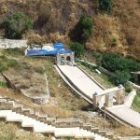
- The cable car – From the eastern compound, a modern cable car ascends to the “Snake Gate” at the top of the mountain. The new cable car replaces the old cable car from the 70s, it is more assimilated into the environment and less “invading” the site. The old cable car was built in 1971 and raised a limited number of visitors to the point lower than the summit, from where visitors were forced to ascend the summit by stairs. In 1998, the cable car system was replaced to meet the demands resulting from an increase in the number of visitors to the site. The lower cable car station was built at the foot of the mountain and became part of the visitor center complex. The stairs at the top station have been eliminated, and the entrance to the fort today is through a suspension bridge, also passed to people with disabilities.
- The Snake Trail – You can also climb Masada on the “Snake Trail” – about a half hour walk
The western compound
Access to Masada National Park from the direction of Arad (Route 3199).
- “Masada invests in sunrise”: The new nightly show – let’s get to know the multi-faceted story of Mount Masada in an exciting way: a spectacular show in the heart of the desert.
- Roman siege vessels – at the foot of the embankment are reconstructions of Roman siege vessels, which were used in the film – “Masada” by Universal in 1979.
- Overnight car park – Overnight car park, with permanent tents and camping pitches. The car park has toilets, hot showers, and cooking corners, for a fee.
- The sangar- ascends to the site for 15-20 d, on top of the sangar built by the Romans. The embankment west of Masada is a saddle only 60 m lower than the top of the mountain. In ’73, during the Roman siege of the zealots who fortified the mountain, the Romans took advantage of a natural slum that was in this place, built a dirt embankment on it, and supported it with wooden beams. After a few months, the Romans were able to build a siege tower that destroyed the wall. In response, the besiegers built an improvised wall on Masada, but the Romans set it on fire. Above the battery is missing a section in the bracket wall. This section was destroyed during the siege and from there the Romans invaded Masada.
- Northern Water Cisterns – Herod built an impressive water collection system. Dams he built in the canals of the Masada River diverted the floodwaters into the canals, and the canals filled 12 huge pits hewn on the northern slope of Masada on two levels. The capacity of the cisterns was 40,000 cubic meters. The mountain stage
- The Northern Palace – the remains of Herod’s magnificent private palace, on its three levels, mosaic floors, and restored murals. The northern palace is a bold structure, built at the top of the mountain according to an abyss. The palace was built on three rock steps, with a total height difference of c. 30 m, and its construction required strong retaining walls. The palace was built under the influence of Hellenistic and Roman architecture. The upper step served as Herod’s private residence. The living wing had four rooms and a central hall. The rooms were tiled in geometric patterns, and the walls were decorated with murals. In the southwestern room, a mosaic floor has been preserved in black-and-white hexagonal patterns, a model accepted in Rome and its surroundings, and it is possible that his presence here is a testament to the quarry of the artists who created it. From the outside, a semi-circular balcony was built, which was formerly surrounded by pillars. The balcony overlooks the replica cliff of the Judean Desert, the Dead Sea, and the Roman siege array. In the center of the middle step was a round hall, surrounded by pillars, of which only the foundations survived. However, it was meant for hospitality and amazement. Also in the center of the lower step was a hall surrounded by staves. The exterior walls of the hall were decorated with molded patterns (stucco), and the interior walls – with frescoes (murals painted on damp plaster) in the form of colored marble slabs and geometric patterns. The palace also had a small bathhouse, where the remains of three human skeletons, probably of the rebels, were discovered. In the bathhouse, a woman’s braids were discovered, which were beautifully preserved.
- The synagogue – the remains of one of the only synagogues from the Second Temple period that have been preserved. A building that was used in the days of Herod Stable, was turned into a synagogue by the rebels. Two pits dug in the floor of the room, in which sections of biblical field were found, were probably used as a genizah. Built-in benches were attached to the walls. It is one of the few ancient synagogues that operated at the end of the Second Temple period. South of the synagogue, in the “closing of the scrolls”, a rare collection of finds from the days of the revolt was discovered, including fragments of scrolls and papyruses.
- The Fate Room – Pottery fragments bearing inscriptions, mainly the names of people, were exposed in this place, including “Banyir”, the name of the Sikri leader, the dominant group in the Masada rebels. These may be the fates imposed by the rebels on the night they chose to end their lives. It is also possible that the names are related to the life-management system of the rebel community.
- Western Palace – This palace is the largest building in Masada, it was built in the waters of Herod, measuring 3,700 square meters. In the entrance hall, benches were built, and the walls are decorated with molded models (stucco). The legs of the throne, presumably it was the “throne room.” A staircase leads to a second floor, from which one can overlook a bathroom complex, with a magnificent mosaic floor.
- The Bath House – The bathhouse is built in Roman style, and all its rooms are well preserved. The entrance courtyard is surrounded by pillars, intended for gymnastic exercises. The dressing room (epidodrium) is decorated with murals and special stone tiles. During the revolt, a baptismal facility was built on the site. In the lukewarm room (tepidrium) the murals have been beautifully preserved. An opening in the wall of the room leads to the stepped pool of the cold room (frigidrium), and from the lukewarm room an eastern opening leads to the warm room (calderium), with a floor resting on pillars. Hot air flowed through clay pipes incorporated into the walls and heated the room. From the roof of the bathhouse, views of the entire Masada platform unfold.
- The Census House – a system of rooms decorated with restored murals – The Census Office, adjacent to the “Snake Trail Gate”, has a series of rooms decorated with frescoes (murals painted on damp plaster). Most of the decorations are geometric patterns and marble imitations. Other decorations depict plants.
- The southern cistern – a large cistern for storing water on the mountain platform – is a large cistern, to the bottom of which descends a 64-step staircase. An inscription from a visit by a youth movement in Masada in 1941 was engraved on a wall near the stairs.
King Herod
The cliff was chosen by King Herod to serve as a place of refuge and a royal fortress and on its flat summit magnificent palaces, public buildings, and delights were built. The fortifications surrounded the cliff and water collection and storage systems ensured a continuous supply throughout the year. The dramatic historical events that took place in Masada during the Great Revolt are described in great detail in Yosef ben Matityahu’s book – “The Jewish War”. According to Yosef ben Matityahu, even before the destruction of the Second Temple, Jewish rebels were captured by the Sikhs from Masada, and from there they went on robbery raids on settlements in the Dead Sea area. Masada rose and narrowed, in eight siege camps, the Roman Tenth Legion, and after desperate battles over the fortress walls and resetting the rebels’ hopes of lifting the siege they chose to commit suicide and not end their lives as slaves.
conquest of Masada
After the conquest of Masada in 73, the mountain sank into the abysses of oblivion until it was rediscovered by 19th-century scholars. Intense archeological excavations were conducted in Masada and to a lesser extent in the Roman siege system at its footing from the 1960s when the vast majority of the entire site was excavated and explored.
UNESCO
On a secluded cliff in the heart of a desert, a cliff overlooking the Dead Sea from above and the wild landscapes of the Judean Desert, once a magnificent palace. During the Great Revolt, the last Roman rebels fortified it, making their desperate war a symbol of the struggle for freedom. The fascinating past events that took place on the mountain and the archeological finds in it influenced the declaration of the National Park on the part of the UNESCO World Heritage Site
History of Archaeological Research in Masada
Masada National Park was first identified in 1838 by American scholars Edward Robinson and Eli Smith. The two looked at Masada with an Ein Gedi telescope and identified the building on the northern cliff of Masada as Herod’s palace. Four years later, American missionary Samuel Walcott and British painter William Tipping climbed to the top. They brought accurate drawings and drawings of the site.
In 1848 American naval officers visited the site and identified the cisterns. They were followed by the explorer Felician de Susi, who excavated the Byzantine church and surveyed the Roman siege system. Charles Warren and Claude Conder, members of the British Foundation for the Exploration of the Land of Israel (PEF), surveyed Masada in 1865 and accurate drawings and maps of Masada and the Roman camps. They even located the Snake Trail.
In 1932 the German archaeologist Adolf Sultan spent a month. His work served as the basis for subsequent research, although he mistakenly identified the Northern Palace as a fortification system built at the upper end of the Snake Trail.
Archaeologist Shmarya Gutman led the youth movements in the 1940s and made Masada a symbol. It was the engine that led in 1953 to the first Israeli excavation in Masada, which identified the water supply system, discovered the full route of the Serpent Trail, and identified the northern palace as Herod’s palace. The expedition also excavated Roman camps A and C. A delegation of senior Israeli archaeologists returned to Masada in 1956 for 10 days. Among the researchers were Nachman Avigad, Michael Avi-Yona, Yosef Aviram, Yochanan Aharoni, and Shmarya Gutman.
In 1963, Yigal Yadin’s excavation delegation began digging in Masada. During two seasons, Masada was excavated almost in its entirety. Excavation of parts of Masada was continued later by Ehud Netzer and Guy Stiebel.
walking paths for hiking
Hawari Masada – a proposal for a hiking route
Spring -South -Winter -the Dead Sea and the Judean Desert- Free -admission Circular route -Autumn -half-day Summer- Easy -observation
Here is your chance to take a light walk in dramatic landscapes reminiscent of the moon. This trip is home to quite a few plot twists and works of art from nature
Starting point and end: Start the trip in the lower parking lot, in the eastern part of the national park.
How to get there: “Masada National Park” in Wise
Recommended season: autumn, winter, and spring. In summer suitable as a full moon trip (for those with experience in night trips and after a preliminary preparation trip)
Trivia for the road: The Dead Sea is a remnant of the tongue that stretched in ancient times from the Sea of Galilee in the north to the Hatzeva area in the south.
So many times you have stood high on the summit of Mount Masada, looking at the breathtaking view that unfolds at your feet and assuring yourself that one day you just have to walk through the landscapes with the picturesque marl benefits seen from above.
Well, that day has come.
Hawari on the other hand got their name from the local rock character. But now comes a small twist in the plot: the marl rock, which appears in a light yellow hue, inhabits clay and chalk. But despite its name, it is completely different from the “marl of the tongue” rock, which you will meet today. This is a geological configuration that belongs to what geologists call the “Dead Sea Group”. It is a remnant of the mighty tongue of water that covered the whole area in ancient times. All that is left of the sea for centuries is the Dead Sea of today, and also these special sedimentary rocks, which are not composed of marl at all.
Now, after the trivia detail that changed everything you thought about marl, you can set off.
From the eastern parking lot of Masada National Park, where there is a large bus parking lot and a cluster of palm trees, descend a black path heading south and penetrating into the wadi. Already at the initial stage of the hike, you will relish the beautiful rock formations, which look like layers and reliefs laid on top of each other, a result of generations upon generations of drifting, creasing, flowing, and everything in between. Real art from nature, requires you to stop, observe and also photograph all this beauty
As you walk slowly in the deep channels, the marl cliffs rise above you, like palaces that reach a height of eight meters and more. If you take this route as a night trip in full moonlight, you will find that there is almost no need for a flashlight, as the light-tongued marl rocks reflect the moonlight well. One way or another, it is worth knowing that these rock formations were formed 70-15 thousand years ago – relatively young geologically.
You will soon reach a green and black trail junction. Those interested in a linear route (which reaches the banks of Route 90), will continue on the black trail. Those who are interested in the circular route will continue with the green in a southerly direction, and after about 600 meters, rejoin the black trail, and from this point – back to the starting point of the route.
The information provided here is a trip recommendation only. The use of the information is the sole responsibility and responsibility of the traveler. It is recommended to check before each trip the weather forecast and the flashes on the website of the Nature and Parks Authority, you can contact the call center every day until 16:00 at 3639 *
Ein Bokek The long route – a recommendation for a hiking route in the Judean Desert Nature Reserve
Spring -Picnic area -South -Winter -Overnight camp -Excursion with children-Blossom -trip -the Dead Sea and the Judean Desert -Entrance to the water for hikers- A circular route- Autumn -half a day -Summer- Observation
Between Arad and the southern part of the Dead Sea lies a particularly magical hiking route to a cool and beautiful desert oasis – Ein Bokek, where you can enjoy a flowing stream, springs, and plenty of stream vegetation. In the long version of the route, which is suitable for hikers, you can enjoy a cool hike even on hot summer days!
Ein Bokek. Nahal Bokek is one of the shortest streams in the Judean Desert, only about 15 km long and drains part of the desert plateau area. A beautiful green desert, with a large variety of animals and plants that are attracted to its clear waters.
On the long hike to the lower part of Nahal Bokek, which is suitable for hikers, you can enjoy a flowing stream, full pools, waterfalls, stairs and dams, abundant vegetation and remains from the Hasmonean and Roman periods. A trip of a few cool hours that is also suitable for hot summer days!
From the parking lot in the Ein Bokek hotel complex, there is a path marked in black that crosses Road 90 in an underground passage. To the west of the road is a path marked in red to Ein Noeit (“the Roman spring”) near the side of Bokek. Today the spring does not flow, but the vegetation that grows here indicates water close to the ground. Ein Noait is a replica spring whose waters come from great depths and contain radioactive materials. It seems that in the distant past they thought that water had medicinal properties and poured it into a bathhouse built near the spring. Today it is difficult to notice most of its buildings and only on the side, high walls have survived.
Remains of a settlement from the Hasmonean period were exposed in the key of the stream, in the modern hotel complex. In the days of Herod, Ein Bokek was a center for the processing of medicines and cosmetics. Around the center were cultivated terraces over 350 acres, and aqueducts led the waters of Ein Bokek and Ein Noay to two square pools. In the Byzantine period (4th century AD), the government established aside at the foot of Ein Noait – a cell in the “Limes Palestine” fortress chain that defended the southern border of the country. Masad Bokek was assigned an important role in this formation: he blocked the road to Ein Gedi and secured the road that ascended Mount Hebron via Ma’ale Bokek.
From the side, the red path ascends and meets a path marked in black, where you descend steeply to the left to Nahal Bokek. On the way, the fixed pegs in the rock are used. The trail descends to the creek near the small rock waterfall. Close to the Dead Sea Road, on the northern cliff, you should pay attention to black boulders. These are the asphalt rocks of the Ein Bokek formation, and they contain oil shale (bitumen) from a plant-organic source. Want proof? Rub dark rock fragments against each other and sniff them!
Now cross Route 90 at the underground water pass and return to the parking lot of the Ein Bokek Hotels.
How to get
Nahal Bokek crosses the Dead Sea Road (90) near the 212 km mark. It is recommended to park near one of the Ein Bokek hotels and cross the road west safely in the creek channel, under the road bridge.
Remarks
Do not deviate from the marked path.
Do not enter the creek on rainy days.
Be careful on the steep path.
The information provided here is a trip recommendation only. The use of the information is the sole responsibility and responsibility of the traveler. It is recommended to check the weather forecast and the flashes on the Nature and Parks Authority website before each trip, you can contact the call center every day until 16:00 at 3639 *.
pay attention
During hours when the path is closed, the ascent and descent from the east (Dead Sea) are by cable car only, for a fixed fee.
For details and to register for the Masada Museum, click here
For details and registration for the night show in Masada West – click here
In winter and the transition seasons there is a danger of floods that can be life threatening! It is the responsibility of the visitors to be updated near the departure of the trip in the weather forecast
(On the Meteorological Service website or in the news edition) and be updated on the status of the routes in our flash complex.
In cloudy weather do not walk or cross riverbeds!
pay attention:
The Snake Trail is open to visitors every day – opens an hour before sunrise and closes an hour before the site closes.
Getting there from Route 90 – climbing time to the top – about an hour. Difficulty – high.
The battery trail is open to visitors every day – half an hour before sunrise – arrival from Arad – climbing time to the top – about half an hour. Difficulty – Medium.
If you have registered in advance, arrived at the site and there is no space available – you will be asked to present at the entrance the confirmation of “coordination of the date of the visit” to enter.
Opening Hours
The entrance to the national park closes an hour before the closing hours.
The last cable car goes up the mountain an hour before closing. Entrance to the museum by appointment only.
Daylight Saving Time:
Sundays – Thursdays and Saturdays: 17:00 – 08:00 Fridays and holiday eves: 16:00 – 08:00
winter clock:
Sunday – Thursday and Saturday: 16:00 – 08:00 Fridays and holiday eves: 15:00 – 08:00 on the eve of Rosh Hashanah and on the eve of Passover: 13:00 – 08:00 on the eve of Yom Kippur: 12:00 – 08: 00
Extensive information
History
Sources of information- The only significant historical source in the Second Temple period that tells of Masada is Yosef ben Matityahu, who gives a brief description of the history and structure of Masada, as well as of the course of events during the Great Revolt. During the Roman siege of Masada, Josephus was already in Rome, and his knowledge of his course could only come from a second vessel, through the reports of the returning Roman soldiers (Masada is also briefly mentioned in the writings of Strabon and Pliny the Elder.
Knowledge of Masada was drawn from the letters of Yosef ben Matityahu, and not from any other Jewish source. It has no mention in the Mishnah and the corresponding sources, nor in the Babylonian Talmud or the Jerusalem Talmud. A version of the story appears in the book of Josephus, with some changes (the name of the rebel leader is changed, as is the story of the suicide).
A Masada story does not appear even when there is a reference in a halakhic discussion to a situation where a person is considering suicide so as not to fall into the hands of his enemies; The example given in Halacha (in Shulchan Aruch, part of Yoreh De’a, 345) is that of King Saul on Mount Gilboa (Sefer Shmuel I, 51) and not the example of Masada.
The reason for this is unclear, and there are several hypotheses: some speculate that the reason is that the Sikhs were a stream that divided the Pharisees, who ruled after the destruction of the Second Temple, and therefore were not considered an object of study or discussion. There were also those who speculated that the Pharisees wanted to prevent further destructive revolts such as the Bar Kochba revolt, and therefore concealed events that could have led to a national awakening.
Opposite the historical sources is the archaeological find – which includes a few writings left behind by the inhabitants of the fortress in the various generations, as well as “ilem” finds.
The ancient periods
The earliest remains discovered in Masada were left by the people of the Chalcolithic period, who used caves in the body of the southeastern cliff of the mountain. Some potsherds from the Iron Age in the Land of Israel were found scattered throughout the mountain, but no sign of construction was discovered during this period.
the Hellenistic Period
According to Yosef ben Matityahu, the first to build in Masada was “the high priest Jonathan.” It is possible that he was referring to Jonathan Whoopsy or Alexander Yanai, while elsewhere he writes that the fortress was built by “kings of days gone by.” A number of potsherds from the Hasmonean period were found in various places on the mountain, as well as a dozen Ptolemaic coins, four of Jonathan Vopsi’s coins and dozens of Alexander Yanai’s coins.
There is nothing left of the construction on the mountain during this period, except for two cisterns that may have been hewn during this period.
The Herodian period
The history of Masada begins, in effect, with the history of Herod the Great. Herod, cynically exploiting the political turmoil in the Roman Empire after the assassination of Julius Caesar, and the power struggles between the claimants to the Hasmonean dynasty became a key figure in Palestine politics and won the support of the rulers of Rome as the designated king of the province of Judah. However, Herod’s status and his way to power knew ups and downs.
In 40 BCE, the Euphrates invaded Judah, and placed Matityahu Antigonus II on the throne of Jerusalem. Soldiers. Herod managed to escape to the kingdom of the Nabataeans and from there to Brundicium (Brindisi) and by decision of the Senate was crowned king in 40 BC in Rome. In its absence, for its part, it was besieged by Herod’s enemies. In 39 BC Herod returned to Israel, freed his family from the siege of Masada and in a series of battles succeeded in 37 BC in taking control of the country, and under the auspices of Marcus Antonius, the Roman governor of the East, proclaimed himself king.
The big rebellion
In 66 AD, at the beginning of the Jewish revolt against the Romans, a group of Jewish rebels called the Sikhs conquered Masada from the Roman garrison stationed there. In 70 they were joined by other Sikri and their families who were deported from Jerusalem shortly before the destruction of the Second Temple. For the next two years, the Sikhs used Masada as a base for raids and harassment of both Roman and Jewish settlements, led by their leader Elazar Ben Yair.
The siege according to Yosef ben Matityahu
According to the description of Joseph ben Matityahu, the Roman commissioner, Flavius Silva, laid siege to Masada at the head of the Tenth Legion and other auxiliary units. The Straits built a siege embankment on the western side of the plateau. The peak height of the embankment was, according to Yosef Ben-Matityahu’s description, lower than the height of the Masada wall, so it was necessary to build a wide platform that was built of well-matched stones. Above this stone platform a ram was built that allowed the Romans to break through the fortress wall.
When the stone wall collapsed a wooden wall erected by the defenders at the break-in point was discovered, the Romans set fire to the wooden wall and tightened the siege to the moment of the break-in set the next day. The leader of the defenders decided that hope had been lost to survive the siege and repel the Romans and decided that the only way out was the suicide of all those on the mountain.
Yosef ben Matityahu’s dramatic description culminates in Eleazar ben Yair’s two-part speech, in which Eleazar argued for the right to liberty, and his main argument is the preference for liberty over life. The next day, when the Romans entered the fort, they discovered that its defenders, about a thousand men and women, including old children and toddlers, had set fire to all the buildings and committed suicide. This version of the story of the siege of Masada was given, according to Yosef ben Matityahu, by two women who survived the suicide while hiding in a cistern with five children.
The act of suicide
State-military funeral for skeletons found in excavations on Masada, 1969
State-military funeral for skeletons found in excavations at Masada, 1969. Photo from the Danish Dan Collection.
The act of suicide has raised many difficulties for historians. Suicide is contrary to Jewish law (see paragraphs ‘sources of information’ and ‘rabbinic tradition’), but there were cases of suicide during the Great Revolt, such as in Yodfat, when the survivors of the city who hid in the cave decided to kill each other and not fall into the hands of the Romans. Jews preferred to jump from the top of the mountain to their deaths rather than fall captive. Another difficulty in obtaining a suicide description is in the absence of conclusive archaeological evidence supporting the mass suicide version.
There is evidence that the defenders of Masada set fire to buildings in Masada, but the excavations found the bodies of only about twenty-eight rebels, three of them, a young man aged 20-22, a young woman aged 17-18 whose junction was beautifully preserved, and a boy aged 11-12 The northern. Another twenty-five skeletons of rebels, men and women of various ages, were found in a cave under a wall on the southern cliff. The remains of the other bodies, about nine hundred according to Yosef ben Matityahu, were not found.